
September 18, 2026
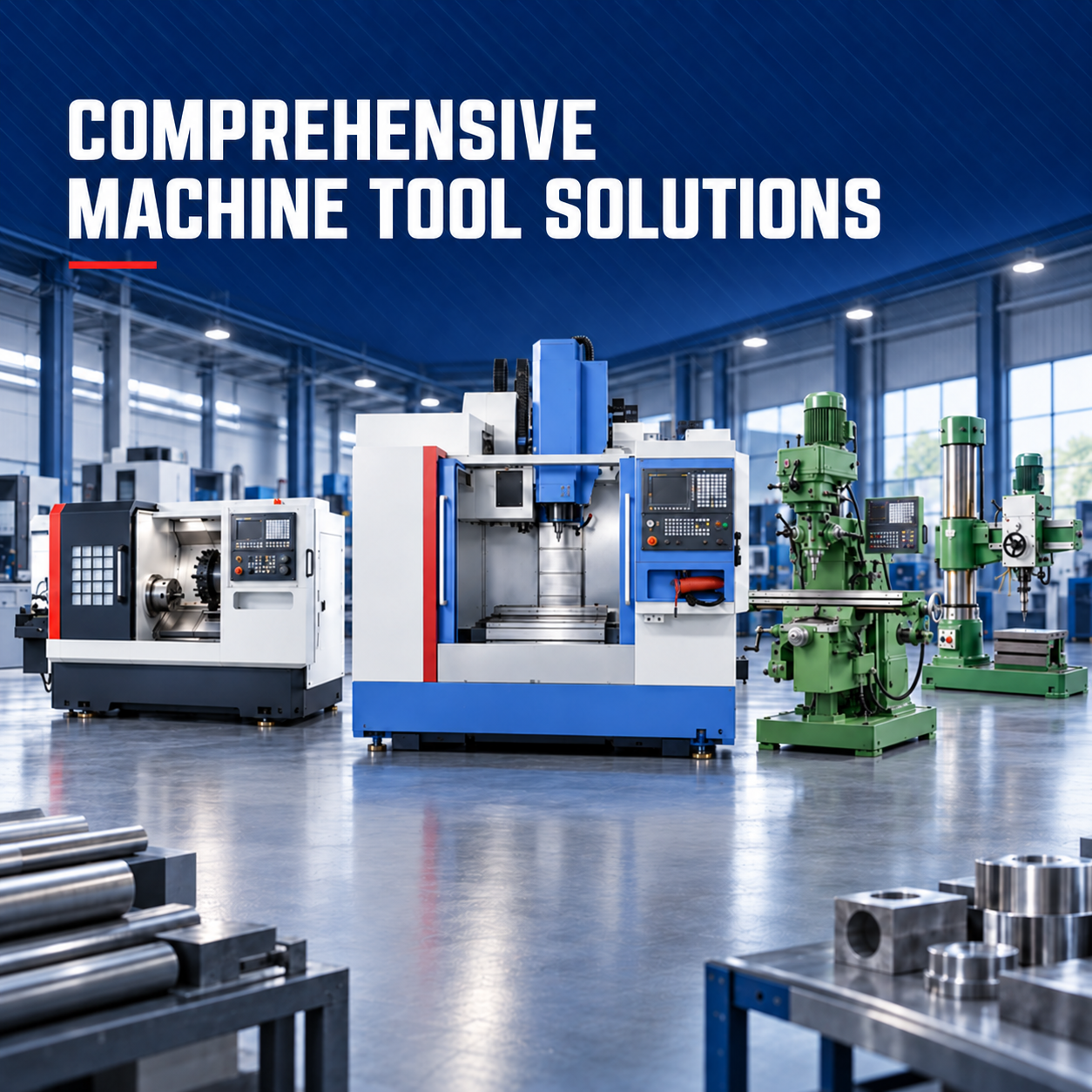
Table of Contents
1. Introduction The Backbone of Continuous Factory Operations
2. Core Product Portfolio
3. Application Coverage Industries We Serve
4. Technology and Performance Features
5. Quality Assurance and Service Support
6. Frequently Asked Questions
1. Introduction The Backbone of Continuous Factory Operations
Modern manufacturing depends on machine tools that deliver consistent accuracy, high productivity and minimal downtime. From automotive powertrain components to aerospace structural parts, from heavy equipment fabrication to precision mold-making, the choice of machining equipment directly determines production capacity, part quality and overall operational cost.
From vertical and gantry machining centers to CNC and heavy-duty lathes, milling machines, drilling machines and sawing machines, our manufactured equipment keeps factories running continuously. Our product portfolio is designed to cover the complete spectrum of metal-cutting operations, from rough sawing of raw stock to precision finishing of complex geometries.
The global machine tool market continues to expand, driven by industrial automation, infrastructure investment and the growing complexity of manufactured components. Selecting the right machine configuration, whether for high-mix low-volume job shops or high-volume production lines, requires careful evaluation of workpiece size, material properties, production volume and tolerance requirements.
2. Core Product Portfolio
2.1 Vertical Machining Centers Precision and Versatility for Complex Parts
Vertical machining centers are among the most widely used machine tools in modern manufacturing. Featuring a vertically oriented spindle that approaches the workpiece from above, VMCs offer exceptional rigidity, ease of setup and efficient chip evacuation.
Key capabilities
· Three-axis (X, Y, Z) standard operation, with optional fourth and fifth axes for complex contouring
· Spindle speeds ranging from 8,000 to 20,000 RPM for high-speed machining
· Automatic tool changers with capacities from 20 to 60+ tools for uninterrupted production
· Ideal for precision components in automotive, aerospace, mold and die and general engineering
Our VMCs incorporate high-grade cast iron construction, linear guideways for smooth motion and advanced CNC controls that support high-speed machining strategies. These machines are designed for continuous operation, with thermal compensation systems that maintain accuracy across long production runs.
2.2 Gantry Machining Centers Large-Part Capability and Rigid Construction
For oversized workpieces that cannot be accommodated on conventional machining centers, gantry machining centers provide the necessary capacity and rigidity. The bridge-type structure spans the worktable, allowing machining of large dies, molds, aerospace components and heavy equipment parts.
Key capabilities
· Machining envelopes extending to several meters in X and Y axes
· Heavy-duty spindles capable of high-torque cutting in tough materials
· Double-column design providing exceptional stability under heavy cuts
· Suitable for automotive body dies, aerospace structural frames and large-scale precision components
Gantry machining centers are essential for industries where part size exceeds the capacity of standard vertical machines. Our gantry models feature reinforced bed structures, precision ball screws and advanced coolant systems that support long-duration, high-material-removal operations.
2.3 CNC Lathes High-Speed Precision for Rotational Components
CNC lathes are the standard for producing rotational parts such as shafts, bushings, flanges and other cylindrical components. Our CNC lathe range covers both compact models for small parts and large-capacity machines for heavy industrial applications.
Key capabilities
· Precision turning, facing, threading and boring operations
· Chuck sizes from 6 to 24 inches and swing diameters up to 800 mm
· Programmable tailstock and steady rests for long workpiece support
· Live tooling options for milling and drilling in a single setup
Modern CNC lathes incorporate rigid box-way or linear guideway construction, high-speed spindles and advanced CNC systems that support complex cycle programming. These machines deliver consistent surface finishes and tight dimensional tolerances, essential for mating components and rotating assemblies.
2.4 Heavy Duty Lathes Extreme Load Capacity for Large Workpieces
For workpieces that exceed the capacity of standard CNC lathes, such as large shafts, rolls and heavy industrial components, heavy-duty lathes provide the necessary power and rigidity.
Key capabilities
· Swing diameters exceeding 1,000 mm and center distances up to several meters
· High-torque spindle drives capable of handling tough forging and casting materials
· Robust bed construction with hardened and ground guideways
· Ideal for energy, marine, heavy equipment and steel mill applications
Heavy-duty lathes are built to withstand extreme cutting forces while maintaining positional accuracy. Our heavy-duty models incorporate large-diameter spindles, powerful drive motors and advanced cooling systems that ensure reliable performance under continuous heavy-cutting conditions.
2.5 Milling Machines Versatile Material Removal for Diverse Applications
Milling machines are essential for flat surfaces, slots, keyways and complex profiles. Our milling machine range includes both manual and CNC models, covering a wide spectrum of machining requirements.
Key capabilities
· Vertical and horizontal milling configurations
· Table sizes ranging from compact to large-format
· Wide spindle speed ranges for materials from aluminum to hardened steel
· Suitable for toolrooms, maintenance shops and production environments
Milling machines offer the flexibility needed for both prototyping and production runs. Our machines incorporate precision spindle assemblies, rigid column construction and reliable feed drives that deliver consistent results across diverse materials and part geometries.
2.6 Drilling Machines Precision Hole-Making for Structural Components
Drilling machines are fundamental to hole-making operations, including drilling, tapping, reaming and countersinking. Our product range includes radial arm drills, upright drills and multi-spindle configurations.
Key capabilities
· Hole diameters from small precision holes to large-diameter drilling
· Tapping and threading capabilities for fastening applications
· Radial arm models for large, heavy workpieces
· High-production multi-spindle configurations for high-volume operations
Drilling machines are essential in every metalworking shop. Our models are built with heavy bases, precision spindle assemblies and efficient coolant systems that ensure long tool life and consistent hole quality.
2.7 Sawing Machines Efficient Cutting for Billet and Bar Stock Preparation
Sawing machines are the first step in many manufacturing processes, converting raw bar stock, billets and tubing into workpieces of manageable size. Our sawing range includes band saws and circular saws for diverse cutting requirements.
Key capabilities
· Capacity for cutting solid bars up to large diameters
· Automatic and semi-automatic operation modes
· Precision cutting with minimal material loss
· Suitable for steel, aluminum and other structural metals
Sawing machines contribute directly to material utilization and shop efficiency. Our models feature robust cutting frames, precise feed control and efficient chip removal, ensuring straight cuts with minimal kerf loss.
3. Application Coverage Industries We Serve
Our machine tools are deployed across a wide range of industries:
Industry | Key Equipment Used | Typical Workpieces |
Automotive | VMCs, CNC lathes | Engine blocks, transmission housings, shafts, suspension components |
Aerospace | Gantry machining centers, CNC lathes | Structural frames, turbine disks, landing gear components |
Heavy Equipment | Gantry machining centers, heavy-duty lathes, milling machines | Bulldozer frames, crane booms, mining equipment parts |
Energy | Heavy-duty lathes, CNC lathes | Turbine shafts, generator rotors, valve bodies |
Mold and Die | VMCs, gantry machining centers | Plastic injection molds, die-casting dies, stamping dies |
General Engineering | VMCs, milling machines, drilling machines, sawing machines | Machine frames, gearboxes, brackets, fixtures |
4. Technology and Performance Features
Our manufactured equipment is built around core performance principles:
· Structural Rigidity: Heavy cast iron or welded steel construction ensures stability under cutting loads, maintaining accuracy over long production runs. Ribbed bed designs and reinforced columns minimize vibration and deflection.
· Spindle Performance: High-quality spindle assemblies, including belt-driven, direct-drive and built-in motor configurations, deliver the speed and torque required for specific applications.
· Control Systems: Advanced CNC controls support complex machining strategies, adaptive feed control and real-time monitoring. User-friendly interfaces reduce setup time and operator error.
· Thermal Management: Precision cooling systems for spindles, drives and hydraulic units maintain stable operating temperatures, reducing thermal growth effects on machining accuracy.
· Automation Readiness: Many machines are designed for integration with robotic loaders, pallet changers and part measurement systems, supporting lights-out production for high-volume operations.
5. Quality Assurance and Service Support
Quality is embedded throughout our manufacturing process:
· In-Process Inspection: We monitor critical dimensions during machining and assembly using coordinate measuring machines (CMMs) and laser interferometers. Each machine is tested for geometric accuracy and positioning repeatability before shipping.
· Performance Testing: Machines undergo comprehensive testing under simulated production conditions, including spindle run-out, thermal stability and cutting performance on representative workpieces.
· Service and Support: We provide installation, commissioning and operator training. Our spare parts network helps minimize downtime. Application engineering support is available for optimizing machining processes and achieving productivity goals.
6. Frequently Asked Questions
Q1: Which machine tool is most suitable for a job shop with a wide variety of parts?
A: Vertical machining centers and CNC lathes are the most versatile. VMCs handle a broad range of prismatic parts, and CNC lathes cover cylindrical workpieces. For small shops, a VMC plus a CNC lathe provides an excellent foundation for most job shop applications.
Q2: How do gantry machining centers differ from vertical machining centers?
A: Gantry machining centers use a bridge-type structure spanning the worktable, enabling machining of much larger workpieces that cannot fit on standard VMCs. They offer greater rigidity and are generally used for heavy-duty cutting in large-part applications.
Q3: What maintenance is required to keep machines running continuously?
A: Routine maintenance includes lubrication checks, coolant monitoring, way cover cleaning and spindle temperature tracking. A preventive maintenance schedule based on machine operating hours, typically at 1,000-hour intervals, is recommended for critical systems.
Q4: Can your machines be integrated with automation systems?
A: Yes. Many of our machine tools are designed with automation interfaces that support robotic loaders, pallet change systems and part measurement probes. We provide integration support to suit specific production requirements.
Q5: What is the typical delivery lead time for a standard machine?
A: Standard models typically have lead times of 4-12 weeks, depending on configuration and options. Custom machines with specific specifications may require longer lead times.
Q6: Do you provide operator training and after-sales support?
A: Yes. We provide training at our facility or on-site, including machine operation, programming basics and preventive maintenance procedures. After-sales support includes spare parts supply, phone or remote troubleshooting and on-site service.