
August 10, 2026
Why More Manufacturers Are Choosing Medium-Size Machining Centers for Flexible Production
In modern manufacturing, bigger machines do not always mean better results.
Many factories face a practical challenge: they need reliable machining accuracy, flexible production capability, and stable operating costs — but they do not necessarily need an oversized CNC machine that occupies large factory space.
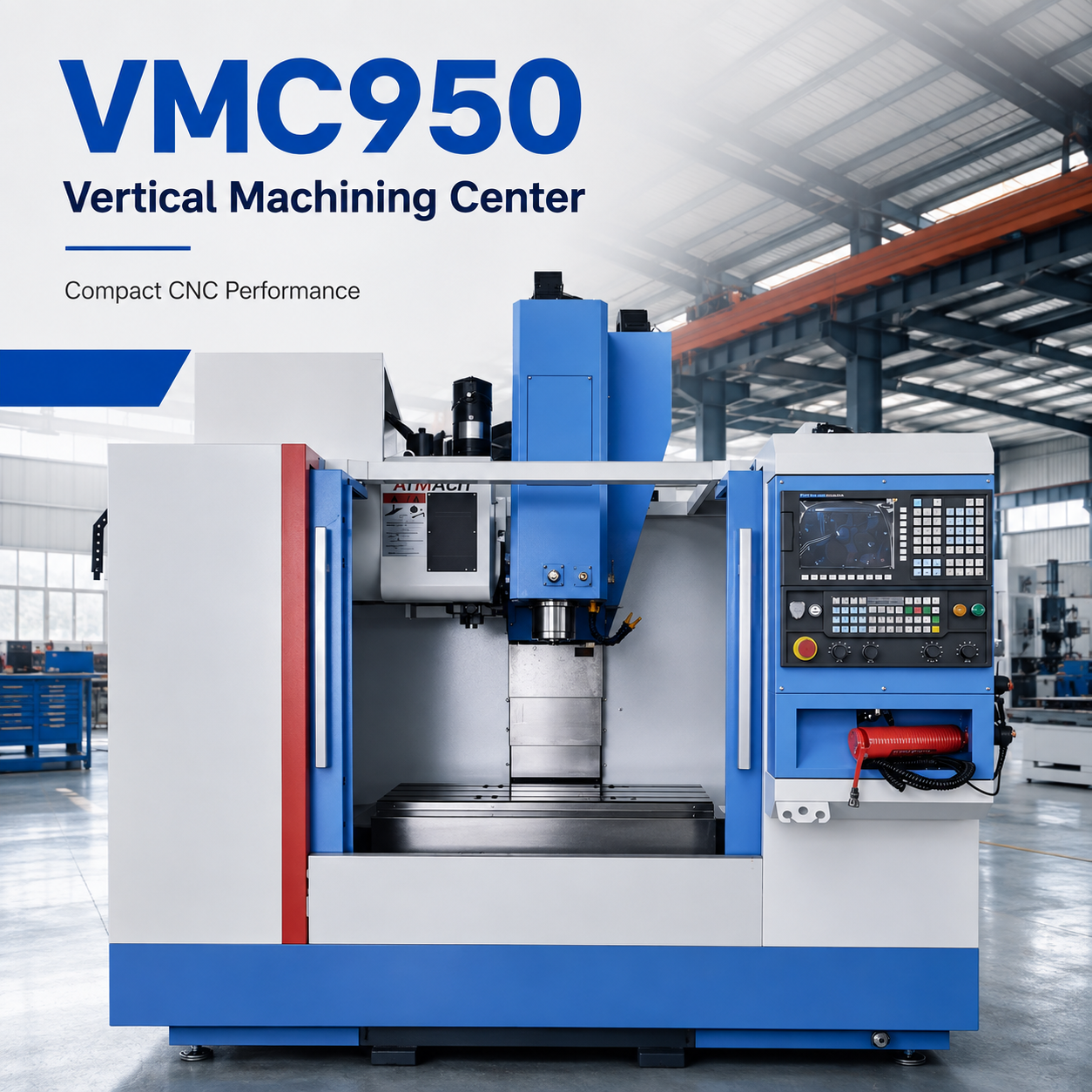
For manufacturers producing precision components, molds, mechanical parts, and small-to-medium industrial products, the VMC950 Vertical Machining Center offers a balanced solution.
This type of vertical machining center provides enough working capacity for a wide range of machining tasks while maintaining flexibility in production planning. It is especially suitable for manufacturers handling multiple product types, frequent order changes, and medium-volume production.
The global manufacturing industry is moving toward more flexible production models. According to data from international manufacturing research organizations, demand for CNC equipment continues to grow as companies invest in automation, digital manufacturing, and higher machining accuracy.
However, selecting a CNC machine is not simply about buying the largest model available.
The real question is:
Does the machine match your production requirements today while supporting future growth?
For many manufacturers, a VMC950-class vertical machining center provides the right balance between machining capability, investment efficiency, and factory adaptability.
Table of Contents
· What Is a VMC950 Vertical Machining Center?
· Why Medium-Size CNC Machines Are Becoming More Popular
· How VMC950 Improves Production Efficiency
· Important Factors When Selecting a Vertical Machining Center
· Application and Material Comparison
· Quality Control Behind Reliable CNC Equipment
· Real Manufacturing Application Example
· Common Purchasing Mistakes
· Frequently Asked Questions
· Final Considerations Before Investment
What Is a VMC950 Vertical Machining Center?
A VMC950 Vertical Machining Center is a CNC machine tool designed for precision milling, drilling, tapping, and multi-operation machining processes.
Compared with traditional milling equipment, a vertical machining center integrates CNC automation, allowing manufacturers to complete complex machining tasks with higher consistency and less manual intervention.
The machine uses a vertically positioned spindle system, where cutting tools move along programmed axes to remove material from a fixed workpiece.
A typical VMC950 configuration belongs to the medium-size machining center category, providing a practical working range for many industrial applications.
Common characteristics include:
· Approximately 950 mm X-axis travel
· Medium working table capacity
· BT40 spindle tooling system
· CNC-controlled multi-axis movement
· Compatibility with various metal materials
This configuration makes it suitable for companies that require precision machining but do not need extremely large-scale equipment.
Typical applications include:
· automotive components
· machine parts
· industrial fixtures
· aluminum housings
· mold components
· engineering prototypes
Why Medium-Size CNC Machines Are Becoming More Popular
Manufacturing requirements have changed significantly over the past decade.
In the past, many factories focused mainly on producing large quantities of standardized products.
Today, many manufacturers deal with:
· customized orders
· shorter production cycles
· smaller batch sizes
· faster product updates
This change has increased demand for flexible CNC equipment.
A large machining center may provide more capacity, but it can also create additional challenges:
· higher purchase cost
· larger installation space
· increased energy consumption
· more complicated maintenance requirements
For many workshops, the better approach is choosing equipment that matches actual production needs.
A VMC950 Vertical Machining Center provides several practical advantages:
Better Space Utilization
Factory space is an important cost factor.
A compact machining center allows manufacturers to increase production capability without significantly expanding their workshop area.
This is especially valuable for:
· small and medium manufacturers
· job shops
· contract machining companies
Flexible Production Capability
A medium-size vertical machining center can handle different parts by changing:
· CNC programs
· cutting tools
· workholding systems
This flexibility helps manufacturers respond faster to changing customer requirements.
How a VMC950 Vertical Machining Center Improves Production Efficiency
Production efficiency is not only about machining speed.
Experienced manufacturers know that total efficiency depends on the entire process:
· setup time
· machining stability
· operator workload
· inspection requirements
· repeatability
A well-designed VMC950 can improve production performance in several areas.
1. Multi-Process Machining Capability
One of the biggest advantages of CNC machining centers is reducing the need for multiple separate machines.
A single setup can often complete operations such as:
· milling
· drilling
· tapping
· contour machining
This reduces:
· workpiece repositioning
· manual adjustment
· potential positioning errors
For precision components, fewer setups often mean better consistency.
2. Improved Repeatability
For manufacturers producing repeated orders, consistency is critical.
A CNC machining center stores machining programs digitally, allowing operators to reproduce the same process multiple times.
This is especially important for industries such as:
· automotive supply chains
· industrial equipment manufacturing
· precision engineering
Stable repeatability helps manufacturers maintain product quality while reducing production variation.
3. Lower Production Flexibility Barriers
Many manufacturers today are not producing only one product.
A machining workshop may receive orders from different industries within the same month.
A flexible CNC machine allows companies to switch between projects more efficiently.
This is one reason why medium-size vertical machining centers continue to be widely used in global manufacturing environments.
Important Factors When Selecting a VMC950 Vertical Machining Center
When comparing CNC machines, buyers often focus on specifications first.
However, experienced purchasers usually evaluate several deeper factors.
Machine Structure and Rigidity
The machine body directly influences machining stability.
A rigid structure helps:
· reduce vibration
· improve surface finish
· extend tool life
· maintain accuracy over long-term operation
For CNC equipment, structural design is often more important than a single high-performance specification.
Spindle System
The spindle determines cutting performance.
Important factors include:
· spindle speed
· torque capability
· tooling compatibility
· thermal stability
A BT40 spindle system is widely used in industrial machining because it provides a good balance between rigidity and flexibility.
It supports various machining operations and has broad tooling availability worldwide.
CNC Control System
The CNC controller affects:
· programming efficiency
· operator experience
· machining accuracy
Common international CNC systems include:
· FANUC
· Siemens
· Mitsubishi
· other industrial CNC solutions
The right controller depends on the factory’s technical requirements and operator experience.
Application and Material Comparison: Where Does VMC950 Fit Best?
Choosing a CNC machining center should always start with the actual production requirement.
A machine that works well for one industry may not be the best choice for another. Material type, component size, production volume, and accuracy requirements all influence the final decision.
The VMC950 Vertical Machining Center is commonly positioned as a flexible solution for medium-size precision machining tasks.
Industry Application | Typical Components | Common Materials | Why VMC950 Fits |
Automotive Parts | Brackets, housings, fixtures | Aluminum alloy, steel, cast iron | Flexible machining and repeat production |
Mold Manufacturing | Small and medium molds, inserts | Tool steel, alloy steel | Stable accuracy and detailed machining |
Industrial Equipment | Machine components, plates, structural parts | Carbon steel, stainless steel | Suitable working range and versatility |
Prototype Production | Engineering samples, customized parts | Aluminum, plastics, various metals | Fast setup and flexible programming |
General Mechanical Manufacturing | Shafts, blocks, connectors | Steel, aluminum alloy | Multi-process machining capability |
The important point is that a VMC950 is not designed to replace every type of CNC equipment.
Instead, it serves manufacturers who need a reliable machine capable of handling different machining tasks efficiently.
Quality Control Behind Reliable CNC Equipment
When international buyers evaluate a CNC supplier, one question matters more than many technical specifications:
How does the manufacturer ensure that every machine performs consistently?
A CNC machining center is a combination of hundreds of precision components. The final machining accuracy depends on how well these components are manufactured, assembled, and tested.
A professional CNC production process usually includes several key stages.
1. Casting and Structural Preparation
The machine body provides the foundation for long-term accuracy.
High-quality cast iron is widely used in CNC machine tools because of its:
· vibration damping capability
· structural stability
· resistance to deformation
Before final machining, cast components typically require proper stress-relief treatment to improve stability.
This process helps reduce dimensional changes during long-term operation.
2. Precision Machining of Critical Components
The accuracy of a machining center depends heavily on the precision of its core components.
Important areas include:
· guide rails
· machine table surface
· spindle mounting position
· axis alignment
Small errors in these areas can influence:
· machining tolerance
· surface quality
· tool performance
For this reason, experienced manufacturers invest significant effort in precision processing and measurement.
3. Assembly Inspection and Trial Operation
Before shipment, CNC machines require comprehensive testing.
Typical inspection procedures include:
· axis movement testing
· spindle running tests
· positioning accuracy checks
· machining verification
For overseas customers, these steps are especially important because international installation and service involve additional time and logistics costs.
A properly tested machine reduces the risk of unexpected production delays after delivery.
The Role of VMC950 in Modern Precision Manufacturing
The manufacturing industry is moving toward a more flexible production model.
Companies are no longer only competing through mass production. They are also competing through:
· faster response time
· customized solutions
· shorter delivery cycles
· consistent quality
This shift creates opportunities for medium-size CNC machining centers.
A VMC950 Vertical Machining Center can support this trend by providing:
Flexible Production
Manufacturers can quickly change machining programs for different parts.
This is valuable for companies serving multiple customers or industries.
Balanced Investment
Not every factory needs a large machining center.
For many applications, a properly selected medium-size CNC machine can deliver sufficient capability while keeping investment and operating costs under control.
Improved Manufacturing Efficiency
By combining:
· CNC automation
· stable machine structure
· repeatable processing
manufacturers can reduce unnecessary manual operations and improve production consistency.
Real Manufacturing Application Case: Precision Component Production
A typical application scenario can be found in precision mechanical component manufacturing.
Many component suppliers produce parts with medium dimensions, including:
· equipment brackets
· aluminum housings
· machine connectors
· custom mechanical components
These manufacturers often face several challenges:
· frequent product changes
· different material requirements
· limited production space
· demand for consistent accuracy
A medium-size vertical machining center provides a practical answer.
For example, a precision component workshop producing aluminum and steel parts may use a VMC950-class machine to complete:
1. Rough milling to remove excess material
2. Precision finishing to achieve final dimensions
3. Drilling and tapping operations
4. Final inspection before delivery
The advantage is process integration.
Instead of transferring parts between several machines, manufacturers can complete more operations within one machining setup.
This reduces handling time and helps maintain dimensional consistency.
According to global manufacturing trends reported by organizations such as the International Federation of Robotics (IFR), industrial automation adoption continues to increase as manufacturers seek higher productivity and more stable production processes.
For small and medium-sized manufacturers, flexible CNC equipment has become an important part of improving competitiveness.
Common Purchasing Mistakes When Buying a Vertical Machining Center
Buying CNC equipment is a major investment.
However, many buyers make decisions based only on machine price.
This can create problems later.
Mistake 1: Choosing Capacity That Does Not Match Production
A larger machine is not always a better investment.
If the machine capacity exceeds actual production requirements, companies may face:
· unnecessary investment costs
· higher energy consumption
· unused machine capability
A suitable machine should match the actual size and complexity of parts being produced.
Mistake 2: Ignoring Long-Term Supplier Support
A CNC machine is not a one-time purchase.
International buyers should consider:
· technical communication
· spare parts availability
· remote support capability
· documentation quality
A reliable supplier relationship can significantly reduce future operating risks.
Mistake 3: Focusing Only on Initial Price
The cheapest machine is not always the lowest-cost solution.
Total ownership cost includes:
· maintenance frequency
· downtime risk
· operator efficiency
· machining consistency
A stable machine often creates better long-term value.
Frequently Asked Questions About VMC950 Vertical Machining Center
Q1: What industries can use a VMC950 Vertical Machining Center?
A VMC950 is suitable for many industries, including automotive parts manufacturing, mold production, industrial equipment, precision engineering, and general mechanical machining.
It is especially suitable for manufacturers producing medium-size components that require flexibility and stable accuracy.
Q2: Is a VMC950 suitable for small batch production?
Yes.
One of the main advantages of a medium-size vertical machining center is flexibility.
Manufacturers can quickly change CNC programs and tooling setups, making it suitable for customized orders and small-to-medium batch production.
Q3: What materials can a VMC950 machine process?
Depending on tooling selection and cutting conditions, a VMC950 can process common industrial materials such as:
· aluminum alloys
· carbon steel
· stainless steel
· cast iron
· engineering plastics
The final machining performance depends on cutting parameters, tooling, and production requirements.
Q4: What should buyers check before purchasing a CNC machining center?
International buyers should evaluate:
· machine specifications
· supplier manufacturing capability
· quality inspection procedures
· technical support
· spare parts service
A successful CNC investment depends on both machine performance and supplier reliability.
Final Considerations: Selecting the Right VMC950 Vertical Machining Center
A successful CNC equipment investment is not about choosing the biggest machine or the lowest-priced option.
It is about finding equipment that matches real production requirements.
The VMC950 Vertical Machining Center provides a practical balance between machining capability, production flexibility, and factory efficiency.
For manufacturers producing precision components, molds, mechanical parts, and customized products, this type of vertical machining center can provide reliable support for modern manufacturing needs.
Before making a purchase decision, buyers should carefully evaluate machine structure, application requirements, quality control standards, and supplier experience.
Choosing the right machining partner can help companies improve production stability and build stronger long-term manufacturing capability.
If you are evaluating CNC machining solutions for your production requirements, requesting detailed specifications and discussing application needs with an experienced manufacturer can help you select a more suitable configuration.